Another list of tools doesn't tell you which of these is a business you could start.
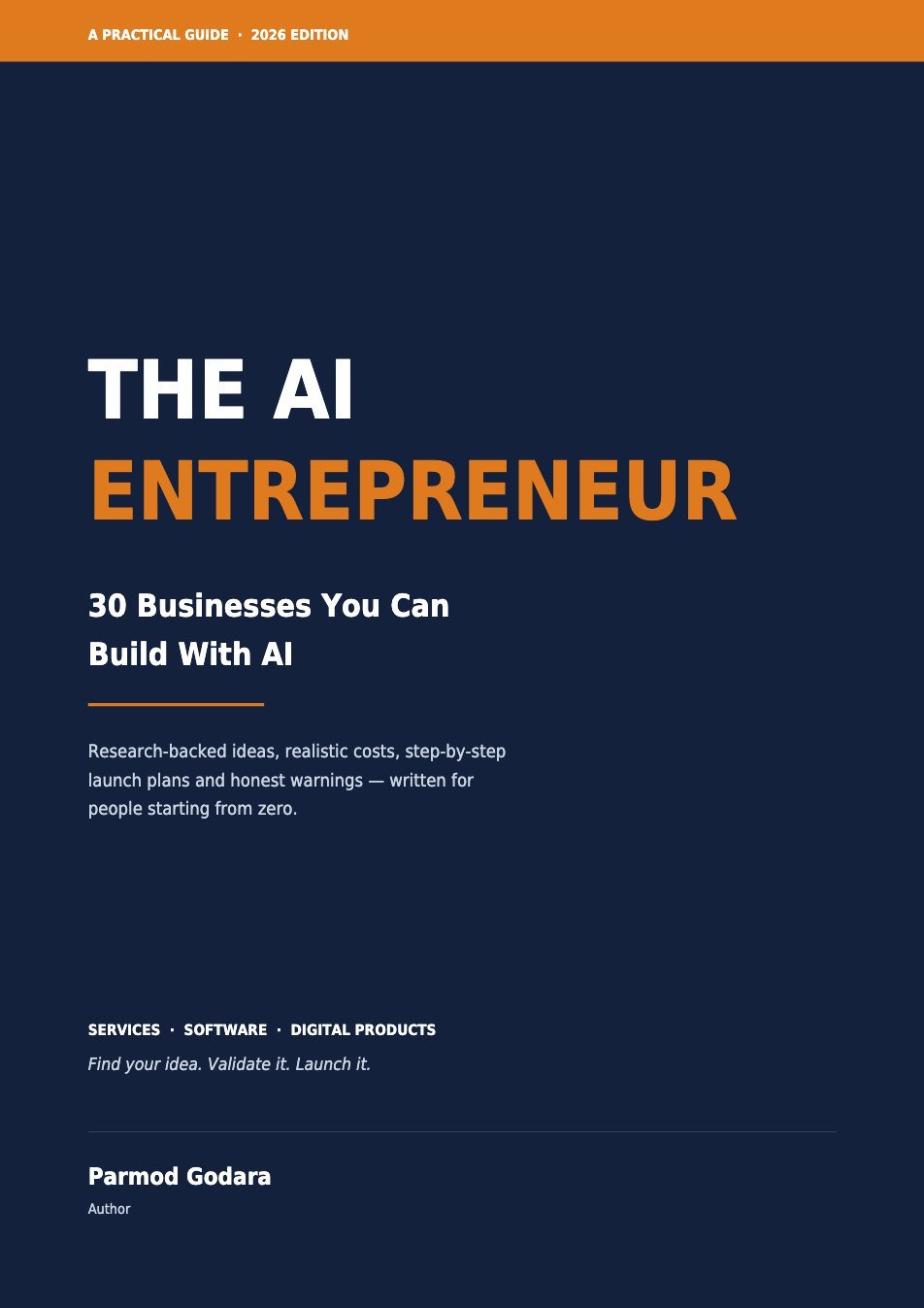
This book does the groundwork for you. It surveys what is working in 2026, narrows it to 30 realistic businesses, and gives you a simple process for choosing one.
Most small and mid-sized businesses don't lack access to AI tools. They lack the time, confidence and know-how to apply them to their own processes. The book is built around that gap, and around the categories current market guides keep pointing to as the most accessible.
Knowing the difference helps you choose a path that suits your money, time and temperament.
Six parts with five businesses each, ordered roughly from easiest to start to hardest.
Model, difficulty and estimated startup cost for every idea, taken from the book's at-a-glance table. Not every idea suits every reader. That is what the choosing scorecard is for.
{{ activePart.title }}. {{ activePart.desc }}
Startup costs are indicative, in US dollars, with approximate rupee equivalents at the book's planning rate of ₹85 per US$1. They exclude your time.
All 30 chapters use the same ten-part structure, so you can put any two ideas side by side and compare them on cost, difficulty, customers and risk.
Connect a client's tools, add AI in the middle, and give them their time back.
Owner-run businesses drowning in repetitive admin: real-estate agents, clinics, e-commerce shops, marketing agencies, accountants and recruiters.
1. Pick one industry and list three repeatable workflows it suffers from.
2. Learn one no-code automation platform and one AI model well.
3–5. Demo, pilot, retainer…
Define scope in writing, since vague requests become unpaid work.
Thirty ideas can feel overwhelming. The book gives you a simple process to get from thirty to one.
Skim the at-a-glance table, read the chapters that catch your eye, and choose three finalists. Starter paths help you begin.
Rate each finalist from 1 to 5 on six honest questions. A total of 24 or more out of 30 is a strong signal.
Talk to ten potential customers, describe your offer in one sentence with a price, then offer a small paid pilot.
A simple four-week plan to go from idea to first customer.
“Aim for imperfect action. A rough pilot with a real customer teaches you more than a perfect plan nobody sees.”
The book assumes you don't yet know which business or which tools. For beginners with little money, it points to low-cost starts like #4 AI Virtual Assistant, #6 AI Content Studio and #21 Prompt and Template Packs.
Writers, marketers and consultants can add an AI offer to existing skills, with market pricing ranges to benchmark against and steps to land a first pilot client.
Compare services, software and digital products side by side: what each costs, how fast it can earn, and how hard it is to prove. Then shortlist, score and test.
See where AI can create new revenue lines, which problems customers already pay to solve, and what to watch for on privacy, consent and accuracy.
Tap a page to enlarge.
Author of The AI Entrepreneur
Parmod Godara is the author and publisher of The AI Entrepreneur: 30 Businesses You Can Build With AI, first published in 2026. The book filters the AI business landscape for realism and presents every idea in one consistent, comparable format.
“The best time to learn is while you earn. Start small, start now, and let your first customer teach you what to build next.”
{{ q.a }}
You don't need to build all 30. You need to find the one worth testing.
30 Businesses You Can Build With AI · PDF eBook · 52 pages
Instant digital access after payment. Educational content; not a promise of income.